By Ana Castillo and Erika Molina
Beyond the exchanges that take place on the ground, Latin America and the Caribbean are going through a pivotal moment in the application of technology to productive and food systems.
According to the study Climate Technology in Latin America and the Caribbean, developed by IDB Lab in collaboration with HolonIQ, since 2010 more than 1,200 technology startups linked to productive systems and the efficient use of resources have emerged across the region, attracting over US$3 billion in venture capital investment.
These solutions span multiple verticals—from precision agriculture and biotechnology to new inputs, traceability, and logistics—reflecting a dynamic and expanding ecosystem.
However, the study also highlights persistent challenges that hinder the scaling of these technologies and their effective adoption by end users. These include the gap between technological development and on-farm adoption, the need for validation under real production conditions, and access to specialized capital that understands the timelines and risks inherent to the agricultural sector.
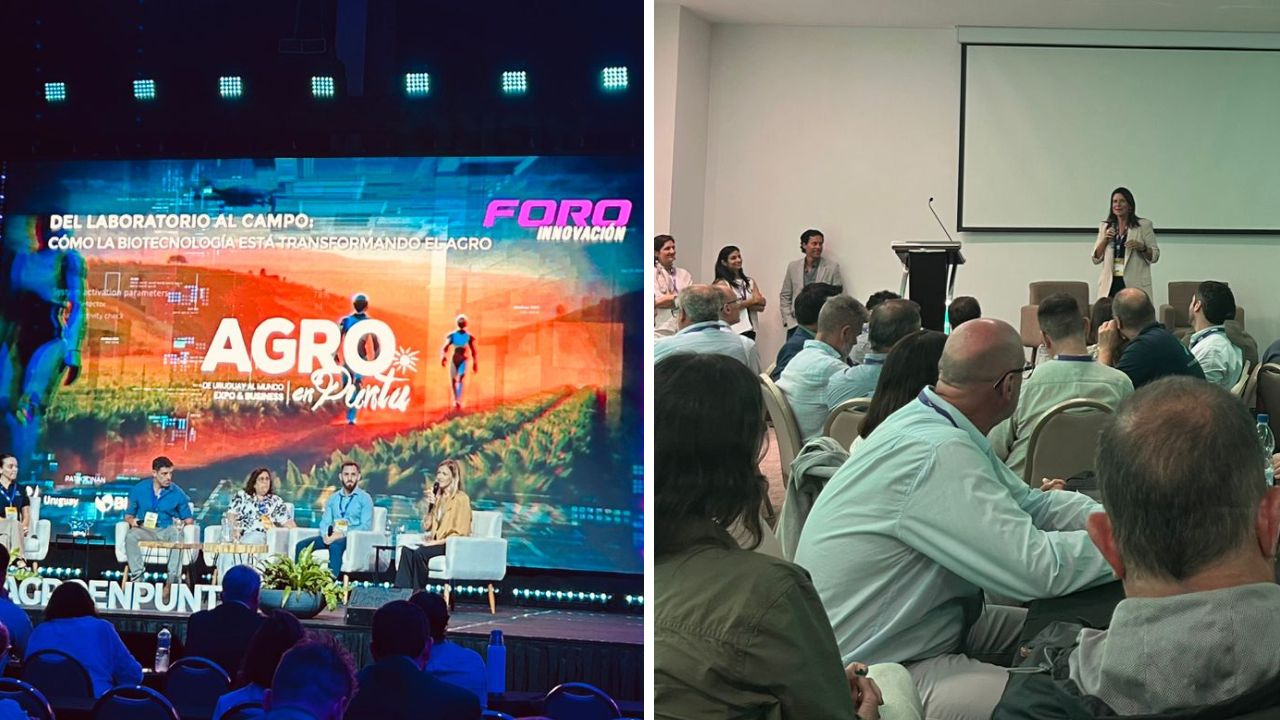
In this context, gatherings such as Agro en Punta play a key role in accelerating innovation adoption by connecting technological solutions with producers and specialized investment.
In this edition, the exchange includes a conversation on how biotechnology and life sciences are reshaping the global productive matrix. Building on the concept of material transition, developed and promoted by El Gato y la Caja, the discussion explores how the convergence of biology, computation, and new microorganism-based production techniques is transforming the way agriculture, livestock, and many other industries operate, at unprecedented speed and scale.
A Space for Direct Dialogue Between Technology and Production
During Agro en Punta, one of the most relevant agribusiness gatherings in Uruguay and the region, IDB Lab actively participates in the innovation vertical, supporting spaces that promote the adoption of technological solutions aligned with real on-the-ground challenges.
Held annually in Punta del Este, the event brings together producers, companies, investors, and public and private sector stakeholders through forums, business roundtables, and exhibition spaces, consolidating its role as a reference platform for agribusiness in the region. Since its first edition, IDB Lab has supported this initiative as part of its strategy to strengthen innovation ecosystems linked to the agri-food and productive sectors in Latin America.
This edition features an Agtech innovation gathering that convenes agricultural technology startups, producers, specialized investors, and other ecosystem actors. The goal is to foster practical, problem-driven conversations and reduce the distance between technological development and real-world adoption.
This space is organized by The Yield Lab Latam, Nesters, and Converge INIA. Converge INIA is part of an operation supported by IDB Lab in collaboration with INIA, aimed at validating AgTech solutions under real production conditions, reducing producers’ perceived risk in adopting new technologies, and accelerating the integration of startup-developed solutions into the productive sector.
Why is This Space Valuable for the Ecosystem?
For startups, these types of forums provide an opportunity to showcase their solutions to real producers, receive direct feedback from end users, and connect with investors who understand the specific dynamics of the agricultural sector.
For producers, the value lies in gaining exposure to technologies designed to address concrete challenges, exchanging experiences with peers, and reducing uncertainty around the adoption of new tools.
For the ecosystem as a whole, the value comes from the interaction among multiple regional actors and the collective learning that emerges from public-private collaboration, creating more favorable conditions for early-stage innovation.
IDB Lab’s Role in the Agri-innovation Agenda
IDB Lab’s participation in Agro en Punta is part of a broader strategy to strengthen innovation in the agricultural sector, promote the adoption of emerging technologies, and consolidate early-stage innovation and investment ecosystems across Latin America.
By supporting spaces like this, IDB Lab helps bring technological innovation closer to the field, ensure validation under real-world conditions, and generate economic value for producers, entrepreneurs, and investors throughout the region.