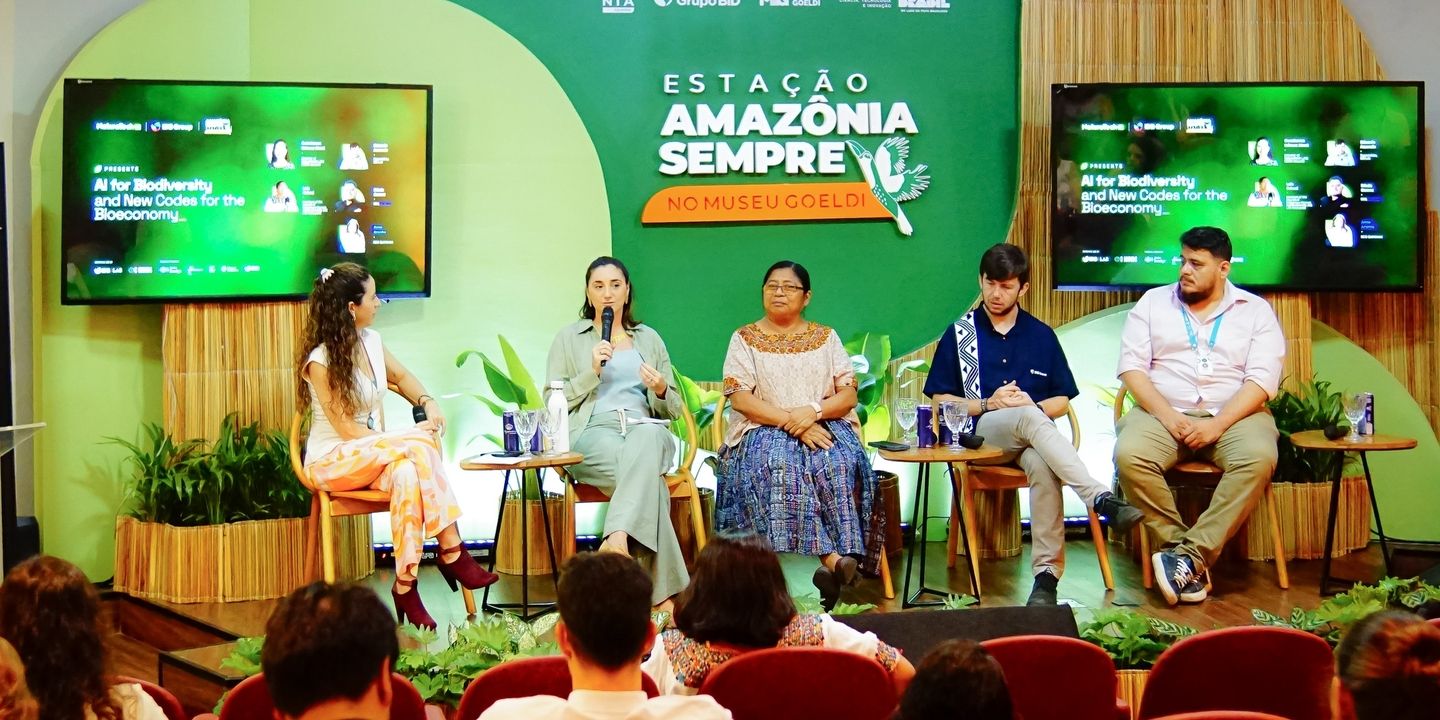
The bioeconomy is moving beyond being an emerging concept to become a key driver of sustainable development in Latin America and the Caribbean (LAC). At the recent COP30, held in Belém, Brazil, this topic took center stage in discussions on climate adaptation and resilience. IDB Lab actively participated in the event, from a preliminary session in São Paulo with 25 fund managers and investors to address climate adaptation, to activities in the forum's Blue Zone, the IDB Group's pavilion in the Green Zone, the Goeldi Museum, and the Bioeconomy Park.
As part of the forum, we presented the report Climate Technology in Latin America and the Caribbean (available in English only), prepared in collaboration with HolonIQ, which reveals some of the figures and numbers that position LAC as a green powerhouse, given the biodiversity of the Amazon (which is the largest in the world) as well as its water and renewable energy resources. Since 2010, more than 1,200 climate technology startups in the region have secured more than $3 billion in venture capital, with 2022 reaching a peak of $875 million. Brazil leads the region with 500 climate technology startups, followed by Mexico with 180 and Chile with 157.
Producing Without Destroying
The challenge of scaling investment in nature-based solutions is at a critical crossroads, as the prevailing model of intensive agriculture relies heavily on chemicals and GMOs, which generate and perpetuate systemic problems.
For example, deforestation and monoculture have disrupted the natural balance between pests and predators, the use of petroleum-based fertilizers degrades the soil in the long term, and increasingly, land must be exposed to and withstand extreme events such as droughts.
In addition, there are financial and regulatory barriers for companies seeking to innovate in the sector, as they require "patient capital" that can withstand long periods of research and development (R&D), but also face complex regulatory processes.
All of the above particularly affects small producers, given the asymmetry of information and lack of access to technology and credit, making them vulnerable to a supply chain system designed to benefit larger players.
Bio-Inputs and the Power of Local Biodiversity
The bioeconomy is based on the production and use of renewable biological resources such as plants, animals, microbes, and organic waste to transform them into valuable products, food, energy, and services, using "biomass" such as crops, wood, and algae.
It is through bioprospecting and the development of bio-inputs that LAC is replacing centuries of fine chemistry with nature-based technologies: fungi, bacteria, viruses, and macroorganisms.
Tripod of Innovation
To bring these types of solutions to market, the SP Ventures fund, in which IDB Lab is an investor, has consolidated a successful model based on a fundamental tripod: academia, entrepreneurs, and venture capital to help scale up the industrial production of technologies born in universities.
In a conversation with Francisco Jardim, General Partner at SP Ventures, we share some of the solutions promoted from the portfolio that are leading, innovating, and generating impactful innovations throughout the region:
1. Promip: Replacing chemicals with natural insecticides
Born at the University of São Paulo (ESALQ) and in partnership with Embrapa, Promip developed macrobiological and microbiological technologies for pest control. They managed to reduce research times and today have a turnover of more than 30 million reais, growing at 50% annually, demonstrating that biological control is scalable and profitable.
2. Gênica: Large-scale climate resilience
Also emerging from academia, Gênica has become a giant that will generate more than R$200 million in revenue in 2025. Its key innovation includes products such as "Rally," a bacterial protocol designed to increase plant resilience to water stress and heat. This year, its technology has already treated more than 1.5 million hectares, protecting crops from the effects of climate change.
3. Puna Bio: Extremophiles for the world
From Argentina, Puna Bio uses "extremophile" microorganisms found in the Puna desert, one of the most cutting-edge areas of today's bioeconomy. Its potential is such that it has attracted investment from the Bill and Melinda Gates Foundation to bring this technology to Africa, seeking to solve soil fertility problems on that continent using science developed in Latin America.
"It is precisely because we are using and transforming local biodiversity into cutting-edge technology that we see startups gaining more capacity and prominence. But we need venture capital to be able to chart an entrepreneurial path that involves laboratories, research centers, and even professors and students to bring that wealth of academia to society and boost the bioeconomy." Francisco Jardim, General Partner at SP Ventures.
A Green Horizon
The bioeconomy in the region has ceased to be a niche market and has become a vibrant and rapidly growing market. According to a CPI study, in Brazil alone, average financing for this sector reached $3.213 billion between 2021 and 2023.
On the other hand, also in Brazil, 93.1% of energy generation in 2023 came from renewable sources, and the green transition is expected to generate up to 15 million net jobs in the region by 2030.
Now more than ever, LAC has the science and entrepreneurial talent to join the global food market in a sustainable and regenerative way. To achieve this, combined financing, technical cooperation, and advisory services will be required to accelerate innovation and ensure its impact.
Yuri Soares

Eduardo Henrique de Azevedo
Senior Specialist at IDB Lab